
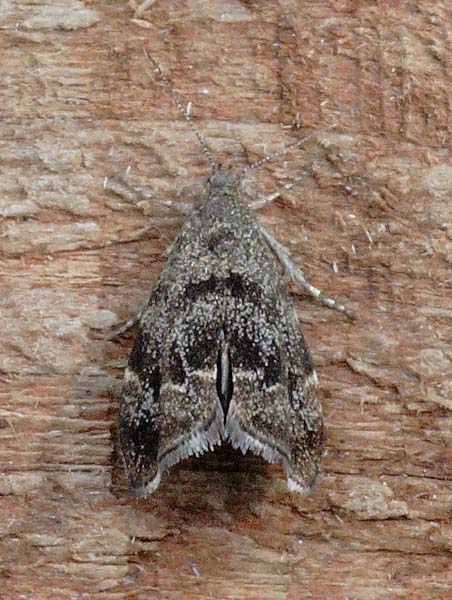
Anthophila fabriciana
48.001 BF385
Wingspan 10-15 mm.
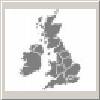
A small, but very common species, occurring throughout Britain.
It is sometimes referred to as the Nettle-tap.
It flies in the daytime from May throughout the summer, and can sometimes be found in large numbers around clumps of nettle (Urtica dioica), the larval foodplant.
Flight period
| Month | Records |
|---|---|
| January | 8 |
| February | 0 |
| March | 2 |
| April | 112 |
| May | 1,074 |
| June | 1,926 |
| July | 606 |
| August | 531 |
| September | 829 |
| October | 392 |
| November | 4 |
| December | 10 |
More details
Foodplant: In untidy web on Urtica leaf. Most often on upper surface, causing it to fold up, but the reverse is often found. August to May and in June, July.
Length: 10 mm Head: Light brown. Posterior of capsule, adfrontal area and frons, blotched brownish black. Adfrontal suture thin dark brown line. Labrum reddish brown. Mouthparts white ventrally.
Prothorax (T1): Prothoracic shield brownish black divided by medial band concolorous with body.
Mesothorax (T2): Large black pinacula; one dorsal pair, one subdorsal, two lateral, one subventral.
Metathorax (T3): As T2.
Thoracic legs: Coxa with black collar, horseshoe shape, open on outer side. Femur and tibia black. Tarsus transparent light brown.
Body: Dull whitish green, lightly shagreened. Translucent, so anterior half darkened by viscera.
Spiracles: Small. Peritreme brown.
Abdominal pinacula: Prominent, large and black. Segments A1 to A8; two dorsal pairs (the posterior more widely spaced), one lateral, one subspiracular, one subventral, one basal. A9; one dorsal pinaculum, two fused lateral, one small subventral, one small basal.
Setae: Colourless transparent.
Anal plate: Concolorous with body, edged brownish black on anterior and laterally. Brownish black mark on anterior and medially.
Prolegs: Base coloured as body. Planta elongated, thin, whitish transparent. Crochets black.